Showing posts with label Shin Megami Tensei. Show all posts

Tuesday, August 5, 2025

Devil Summoner: Raidou Kuzunoha vs. the Soulless Army

Title screen image for Raidou Kuzunoha and the Soulless Army.

Original Release: PS2, 2006. Version Reviewed: PS2, 2006. Platform Used: PS3.


THE PLOT:

After completing his training, devil summoner Raidou Kuzunoha XIV is sent to the Capital to join the Narumi Detective Agency. Not long after he arrives, Narumi receives a call from Kaya Daidōji, the teenage daughter of a wealthy family. Kaya makes a bizarre and desperate plea: She asks Raidou and Narumi to kill her.

Before they can fully process that, mysterious soldiers appear to kidnap her. As the detectives attempt to track down the missing girl, they find themselves drawn into a conspiracy involving the Japanese military, Russian devil summoner Grigori Rasputin, and a horde of demons who all seem focused on the same goal. Unless Raidou can unravel the mystery, not only will Kaya be doomed - so will the Capital itself!

Dogged reporter Tae Asakura's introduction.
Unfortunately, there's not much more to her character.

CHARACTERS:

One of the game's weaknesses is that the characters are shallow. They fall into base types: the cynical detective (who doesn't pay his bills, naturally), the dogged female reporter, and so on. They all have a degree of personality, and the character art invests style and attitude, but there's nothing beyond the surface. The recent remaster's voice acting likely offsets some of this - from what I've seen, the remaster's voice acting is quite good - but these are thin characters on the page, and I found it impossible to get particularly invested in any of them.

I did enjoy the supporting character of Rasputin, however. He doesn't have any more depth than the others, but he is over-the-top in a way that's a lot of fun. When you battle him, his "fighting move" involves doing a Russian dance, while he summons Russian dolls to help him - both things that I found utterly hilarious. It helps that his appearances tend be both brief and limited, so there's no chance to get tired of him.

Combat consists of clunky button mashing.
Normal combat encounters mostly involve clunky button-mashing.

COMBAT:

Given the frequency of random encounters, you'll be spending a lot of time in combat. This is a problem, because in the original version, Raidou's combat is... well, bad.

Atlus attempted to perform fusion between hack-and-slash games and their usual turn-based combat, and it just didn't come out well. The combat largely consists of hacking away at enemies with a three-attack combo. You can summon exactly one demon to assist; if you need a different demon's skills, you have to return that demon and summon the next in mid-battle. In theory, this can be strategic, with a mix of blocks, attacks, and using specialized bullets and/or your demon's magic to hit weak points. In practice, the control and timing aren't there. In random encounters, particularly with multiple opponents, I quickly realized that I was better off ignoring strategy and just hacking away.

You can still exploit enemy weaknesses to capture demons - but instead of negotiation, you first hit its weakness, then hit the "O" button to capture, which brings up the capture mini-game... which consists of still mashing the "O" button as fast as you can.

The boss fight against Rasputin. Boss battles are actually fun.
The boss fight against Rasputin. In contrast to
normal combat, the boss fights are actually fun.

I will say that the combat plays much better in the boss fights. Boss battles usually don't involve large numbers of enemies, making it possible to properly focus on the attacks and movements. Normal encounters in this game aren't difficult once you comprehend the battle system, but they are tedious. Bosses, however, are fun, particularly as the game goes along, because there's usually one specific strategy you have to find to avoid massive damage and deal proper damage on your own part.

The remaster completely overhauls the combat. I know from glancing at online videos that the new version allows players the use of two demons, while also allowing a greater range of movements to block and evade attacks. It looks as if the energy Atlus tried to capture in 2006 actually is present, and I've heard from others that the new version's battles are enjoyable.

In the PS2 version, however, Raidou's combat is mostly a chore.

Raidou explores settings around the Capital.
Non-combat gameplay involves exploring
settings around The Capital to advance the story.

GAMEPLAY:

Non-combat gameplay is familiar, not just from other Megaten games but from RPGs in general. Your hub is Tsukodo-Cho, which is home to: Narumi's detective agency, where you can check in for reminders of plot details and to save your game; Konnou-Ya, the antiques shop where you can purchase healing items and different types of ammunition to hit weak points; and Goumma Den, where mad scientist Victor performs demon fusion.

When you leave Tsukodo-Cho, you enter an overworld map. Explorable areas unlock as the story progresses, and you will return to most or all of them in later chapters either for story reasons or just to hear the various characters comment on new plot developments. Random encounters will trigger as you explore these areas, with lower-level demons in Tsukodo-Cho and higher-level demons in areas from later chapters.

You can also travel to the Shinoda Shrine, where Raidou can enter the "Dark Realm," which offers demon-controlled variants of the regular area maps. I gather that in the remaster, random encounters are limited to the Dark Realm. In the PS2 original, random encounters happen everywhere and with great frequency... which, in fairness, can be good for grinding.

Most chapters involve traveling among different areas to advance the story. Usually, you will have to go to the Dark Realm near the end of the chapter to defeat a powerful demon. This triggers a cutscene that ends the chapter, with an automatic save point at the end of each chapter.

Raidou watches as a witness transform into a demon.
Raidou watches as a witness transforms into a demon.

OTHER MUSINGS:

The first thing I noticed about Raidou Kuzunoha vs. the Soulless Army is that it has a wonderful sense of visual style. Characters' costumes and art deliberately evoke 1940s film noir, and Raidou himself may be the most distinctively designed SMT hero I've yet encountered.

Playstation 2 games often had a "washout" effect, the limitations of the hardware resulting in muted colors and a general preference for blues and greens over brighter hues. Well-designed games often made use of this to enhance atmosphere. This is very much the case here. The muted palette evokes a sense of watching a faded film reel. The reliance on darker colors also helps lend an ominous atmosphere to the Dark Realm. The visuals are matched by composer Shoji Meguro's score; as of this writing, the game's main theme has been firmly stuck in my head for the better part of a week.

The story is structured into twelve chapters, each of which is described as an "episode," each with its own title. They're even structured like episodes of a series, with each having a beginning, middle, and end, and with early chapters seeming related but still narratively distinct.

This is both a benefit and a drawback. Since each episode only takes a few hours to beat, it gives the player a sense of regularly making progress. However, the separation in the early episodes saps the urgency, at least until the chapters become more connected later. I started playing this game before the remaster was announced, going a chapter at a time with breaks in between. I was enjoying it well enough... but the natural break built in by "End of Episode" made it easy for me to set it aside to play something else for a bit.

This changes in the second half, around Chapters 7 and 8. At this point, it clearly becomes a single story, gaining first focus and then momentum. It took me months to play through the first six chapters, but less than a single month to play through the last six. The final dungeon is lengthy and annoyingly maze-like, but I plowed through it quickly because by that point, I wanted to see how the story turned out (for the record, I was satisfied with the ending)..

I suspect I won't be alone in finding the game's first half to be a bit slow and disconnected. My advice to anyone struggling with the early chapters is to stick with it, because the improvement in the second half is worth the slow start.

Raidou and Kaya.
Raidou attempts to protect both Kaya and The Capital.

OVERALL:

From what I've read and videos I've seen, the recent remaster (really more of a faithful remake) fixes or at least offsets the worst issues. From side-by-side comparison videos, I actually prefer the visual look of the PS2 version... but in other respects, based on what I've seen, the remaster appears to be the better version of the game.

That said, I didn't play the remaster, I played the original. I enjoyed it. It's wonderfully stylish, the plot is bizarre but intriguing, and the atmosphere is aided by a terrific music score that switches from upbeat and jazzy to ominous to match each dramatic cue.

If you have a PS3, as of this writing the original versions of both Raidou games are available for about $10 each on the PS3 store, and I definitely feel that I got my money's worth. But it's a flawed game, with weak characters and horribly clunky combat - and since that's the version I played and that's the version I'm reviewing, my score has to take those issues into account.


Overall Rating: 6/10. I suspect you can bump that up to a "7" for the remaster.

Sequel: Digital Devil Summoner - Raidou Kuzunoha vs. King Abaddon (not yet reviewed)

Review Index

To receive new review updates, follow me:

On BlueSky:

On Threads:

Sunday, March 10, 2024

Tokyo Mirage Sessions

Original Release: Wii U, 2015. Version Reviewed: Wii U, 2015.


THE PLOT:

When Tokyo high school student Itsuki Aoi attends an audition for the next Japanese idol , he is shocked to find his childhood friend, Tusabasa Oribe, participating in!

Tsubasa's older sister had been a successful idol... until five years ago, when she vanished while performing in an opera - along with all the other performers and the entire audience! Tsubasa hopes that following in her sister's footsteps will help her to discover the truth about what happened.

This actually works, though not in the way she expected. Midway through her audition, a mysterious portal appears. Strange beings emerge, kidnapping Tsubasa. Most of the audience is paralyzed, drained of all energy, but Itsuki remains unaffected. He chases his friend's captors through the portal, into a mysterious labyrinth populated by monsters. There, he discovers a new power - one that first helps him to free Tsubasa, then sees him enlisted by Fortuna Entertainment into a quest to not only to save the world, but - even more terrifying - to become a part of Tokyo's entertainment industry!

The heroes unite against a threat to the entire world.

CHARACTERS:

This isn't technically a Persona game, but it hews pretty close to that formula. The main characters are a mix of teens, each driven by things that are revealed during optional "side stories." Reckless Touma participates in live "hero shows," and recalls to Itsuki how such cheesy entertainment helped to give him hope during a difficult childhood. Half-Caucasian actress Ellie seems brash and annoyingly obsessed with all things Hollywood, but we gradually realize just how much of her behavior stems from insecurity, with her light skin and European features making her an outsider in an insular society. Child star Mamori is so eager to please those around her that she has difficulty standing up for what she wants. Even the characters who initially seem one-note or irritating are revealed to have a degree of depth, and by the end even the most standoffish of them has emerged as entirely likable.

There are two unfortunate exceptions, however. Tsubasa could pretty much be described as "anime girl," with none of her side stories building any particular personality beyond that. This is a major problem, because the first third of the game revolves almost entirely around her. Even when she becomes less prominent later on, it's clear that she's the female lead - and I'm sorry, but as a character she is incredibly boring.

Then there is the gaping hole at the game's center: Itsuki himself. His character art is drawn to be blandly pleasant, and that description applies pretty well to him as a whole. I can almost see what the developers were going for in a few scenes, ones that actually turn his lack of direction into text... but since he never progresses from that point, it can't really qualify as an arc. The other, more driven (and interesting) characters push him into every situation. His circumstances change a lot, but he remains very much the same person at the end that he was at the beginning.

In short, the two most prominent characters are a bust, leaving it to the supporting cast to carry the story.

A combat session: a series of chained attacks. 
These can get really long by the end of the game.

GAMEPLAY:

If you've played any Persona game that postdates the PS1 era, then the gameplay is going to be entirely familiar. Roughly half of the game is spent exploring dungeons, each of which is designed around a theme. You will fight enemies - known here as "mirages" instead of demons - and level up your weapons and abilities. Hitting enemy weaknesses will allow your characters to engage in "Sessions," chained attacks that can do devastating damage.

The other half of the game is spent exploring various real world locations, interacting with characters and completing requests that range from minor fetch quests (find a random person's watch or briefcase) to more elaborate stories that will take you back into the dungeons trying to rescue people or recover specific items. This is also where you will complete the side stories that are this game's equivalent to Persona's Social Links, helping out your teammates and revealing their personalities (and usually unlocking new and more powerful attacks in the process).


THE SORT-OF CROSSOVER...:

Tokyo Mirage Sessions: #FE is officially a crossover between the Shin Megami Tensei and Fire Emblem franchises. It would be more accurate to describe it as Persona Lite: The Musical, with a Fire Emblem skin. The gameplay is a direct lift from the Persona series. The tone is lighter than any of the mainline Persona games (never mind Shin Megami Tensei), but it's unmistakably part of that range in all but name.

The Fire Emblem elements are considerably more minor. The "personas" gained from the Velvet Room in the Persona series are replaced by mirages who reside in the "Bloom Palace." Each mirage is a Fire Emblem character selected to match the personality of the individual they're teamed with. Bosses are also drawn from Fire Emblem games, and the story - when it's fully revealed - effectively acts as a sequel to Shadow Dragon... which likely explains why all the mirages are drawn from either Shadow Dragon or Awakening.

Musical number as combat move:
Tsubasa and Ellie perform a mid-battle duet.

NOT FOR ALL TASTES:

Tokyo Mirage Sessions is probably the definition of "not for all tastes."

It has a heavily stylized look. In the "real world," the people you can't interact with are represented by colored outlines, making the faceless crowds appear as ghosts. Only your characters and the NPCs with whom you can actually speak are fully detailed. Characters are extremely tropey, to the point where some of them are initially irritating, though most gain added dimensions as the story goes on. 

It's also a musical. The characters are performers, and many of their side stories culminate in concert performances. This carries over to the in-game combat. Once you've unlocked a character's real world performance, it becomes a special attack that can be triggered in mid-battle... meaning that in the midst of combat, two of your characters will start singing and dancing before unleashing a devastating combo. It's fun (and thankfully, even in the Wii-U version, is skippable so that you don't have to watch the same scene repeated endlessly)... but there's no denying that it's weird.

Oh, and the dialogue is in Japanese with English subtitles. This was certainly a commercial decision, with Nintendo deciding not to throw extra money at a tough-to-advertise title on the already-failed Wii U... but I think it actually works in the game's favor. The only way this could be more Japanese is if Godzilla started stomping around leveling buildings - and you could probably drop such a bit in here without it feeling even a little bit out of place! In my opinion, English language dialogue might actually be a distraction from the overall vibe of the piece.

Itsuki is targeted by a demon... er, shadow... er, mirage!

OTHER MUSINGS:

Tokyo Mirage Sessions was the first Shin Megami Tensei-related game I ever played. As a Fire Emblem fan, I was wary of this title, but my inner completionist refused to let me ignore it. I purchased a used Wii U from ebay (this was years before the Switch re-release), fired up the game... and quickly found myself engaged. It was this game that led me to the Persona series; and revisiting it years later, I still find myself enjoying it.

There are some downsides. The chained sessions, where hitting an enemy weakness allows each of your characters to attack in turn, are very entertaining... for a while. However, a full session chain, with each attack individually animated, can run up to two minutes; if you earn an additional special attack, which will in turn usually earn a new session, you can easily double or even triple that time. That makes for a lot of play time spent just watching your characters attack, over and over again. The Switch re-release fixes this, allowing a "Quick Session" function that fast-forwards the attacks... but if you're playing the Wii-U version, these attack chains are entirely unskippable.

The game allows you to save almost anywhere outside of combat, which is good. However, there is no auto save, which is downright bizarre in a modern game and can easily trip up gamers who have become accustomed to regular checkpoints. Simply put: Save regularly. Save when you enter a dungeon; save before boss battles; save after big cutscenes. Don't be lulled by the generally easy difficulty, because you are never more than one "Savage Enemy Encounter" away from potentially losing an hour or more of progress.

Outside of these annoyances, the game is generally a lot of fun. Sure, the "save the world" plot often gets lost in the shuffle of side quests. "It's the end of the world and we have to stop it!... right after we help Tsubasa with her singing, assist Ellie in landing a big part, and save Mamori's cooking show from a meddling new producer." But it's churlish to complain about that, for two reasons: (1) Many of those side quests are more engaging than the main plot; and (2) There's not a single post-PS1 era Persona game that couldn't be subject to the exact same criticism.


OVERALL:

Tokyo Mirage Sessions is an odd game, even by Shin Megami Tensei standards. That said, I found it highly enjoyable. The characters are likable, the stylized visuals are appealing, the combat is mostly a lot of fun, and - critically for a musical - most of the music is good. I'll admit that it's not for all tastes, and I'd definitely rank it a step or two below Persona 4 or Persona 5. Still, for fans of the franchise, I'd say this is worth checking out.


Overall Rating: 7/10.

Review Index

To receive new review updates, follow me:

On BlueSky:

On Threads:

Sunday, September 20, 2020

Shin Megami Tensei: Persona.

Original Release: Playstation, 1996. Version Reviewed: PSP, 2009.


THE PLOT:

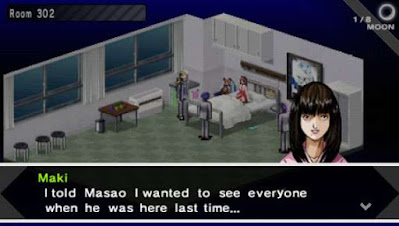
A group of Japanese high school students are visiting their friend Maki in the hospital. She is taken away to the ICU... which abruptly vanishes, just as the town is attacked by demons. The mysterious Philemon grants the power of "Persona" to the teenagers, allowing them to summon manifestations of their inner strength to battle these forces.

It's a power they will need. Kandori, an executive at SEBEC, is using the company's resources to power a reality-altering machine. Now familiar places are transformed into dungeons, crawling with increasingly powerful supernatural forces. The high school has vanished. And Maki... seems oddly connected to almost all of the events.


CHARACTERS:

Characterization is above-average for a mid-1990s Playstation game. Most of the characters are fairly one-note, but they all have distinct personalities. Nanjo (Nate in the 1990s US localization), the rich kid whose family is linked to SEBEC, is serious and decisive, and comes across more as the group's leader in the main story than the player character does; Yukino, a minor supporting character in the main story, takes on that role in the alternate Snow Queen route. Masao (Mark) is brash and constantly making jokes, but clearly has feelings for Maki (Mary). Maki, the character most linked to the plot, ironically ends up being the least interesting of the playable characters!


The characters go to the hospital to visit a sick friend. 
Madness ensues.

GAMEPLAY:

Falls into two main elements. There are rooms and shops where your character can interact with others.  In some cases, interactions unlock additional characters; in most cases, you will gain insight into both the characters and the current state of the story. A town map takes you from location to location, and the game provides regular indications of where you should go next.

The rest of the time, you will be dungeon-crawling. The first person POV takes a bit of getting used to, and I quickly realized that it was more useful to look at the mini-map to navigate the labyrinth-like dungeons than to try to do so visually.  Even in the PSP remake, the halls and corridors are too featureless for visual navigation to be worthwhile.

It's a JRPG, so it's unsurprising that combat and leveling is achieved through random encounters. Combat is turn-based, with options for magic attacks, physical attacks, and a variety of guns (yes, these Japanese high school students are well enough armed for an NRA convention). The interesting curveball is that you can also choose to negotiate with demons. Any of your party members can speak, and each has multiple potential approaches. Some of these will please the demons, others will enrage or frighten them. You'll need to do a balance of both combat and negotiation: Combat for leveling up your characters and Personas, and negotiation for gaining new Personas.


Combat is visually dated, but surprisingly fun.

THOUGHTS:

When games journalists rank the entries of the Persona series, they regularly rank the original game at the bottom. Consensus seems to be that the game has aged poorly, and compares negatively to pretty much all of its successors.

I was surprised at how thoroughly I enjoyed it.

To start with: Yes, it is dated. Even the PSP version, with sharper images and streamlined menus, is very clearly a game from an earlier time. The first person dungeon crawling is visually unappealing, and at times downright ugly. The third-person "character interaction" moments are from a top-down view that makes it feel like you're very far away from the characters, which can limit the sense of involvement. In the PSP version, widescreen reformatting leaves the edges of the screen as a featureless void, which is initially off-putting as well.

I will say that I got through most of the SEBEC route (the main story) without much deliberate grinding. Until the final dungeon, that is, when a sudden difficulty spike rendered my previously unstoppable party into a gang of pathetic weaklings. I ended up tromping around the game's last dungeon for hours, leveling up my characters to equip their Ultimate Personas, then grinding to level up those Personas, before I was able to face off against the game's final boss. Meanwhile, the Snow Queen route requires constant grinding for multiple bosses, then yet more grinding before facing the final boss.

Once I adjusted to the game's look and controls, however, I found myself surprisingly compelled by the narrative. Both the SEBEC and Snow Queen routes offer interesting stories, with ambitious themes about human nature and about the ways people both hide and reveal their inner selves. Its rare to find an archive video game that grapples with such subject matter, often quite successfully. Inspired in part by the work of Swiss psychiatrist Carl Jung, who discussed how the social face we present to the world is basically a mask disguising our true natures, the script has surprising intelligence even as it presents a decidedly outlandish story.

Originally released in the West as Revelations: Persona, the game's PS1 release suffered from an ill-judged attempt to Americanize the story. The characters were renamed, as mentioned. Further, in an attempt at diversity that went horribly wrong, Masao was "blacked up" to be the streetwise Mark, whose dialogue was slathered in stereotypical slang. The PSP version sets this to rights, restoring the Japanese setting and the original character names. It also restores the Snow Queen side story, which was removed from the western PS1 release (though allusions to it remained). These changes make the PSP release the preferable version.

Even the PSP version suffers from misjudgments, however. In an attempt to force it into the mold of the later Persona games, the remake replaces the eerie original soundtrack with pop tunes, which often jar with the story's serious tone. In addition, a handful of fully-animated cutscenes have been added to portray key story points. The animation looks quite good... arguably too good, to the point that the cutscenes can feel jarring compared to the rest of the game.

Overall, however, the PSP version's good points outweigh its bad, and none of its missteps compare with the wrong-headed localization choices of the original Western release. The game itself is much better than I had been led to believe. When I started playing it, I did so as a background game - something to pick at a few minutes here and there. It quickly became a game I for which I would set aside hours-long chunks of time, however, its story and themes involving me to a far greater degree than I had anticipated.

A willingness to accept the quirks of retro-gaming is required to enjoy this.  But I suspect a lot of gamers who haven't played the original might - after a couple hours of adjustment - be as surprised as I was about how engaging this title is, even close to 25 years after its initial release.


Overall Rating: 6/10.


Spinoff: Persona - Anomalous Tower Chronicle

Next Game: Persona 2 - Innocent Sin

Review Index

To receive new review updates, follow me:

On BlueSky:

On Threads:

Persona Review Index

Shin Megami Tensei: Persona
Release Date: September 20, 1996

Release Date: December 1, 2006

Persona 2: Innocent Sin
Release Date: June 24, 1999

Persona 2: Eternal Punishment
Release Date: June 29, 2000

Persona 3
Release Date: July 13, 2006

Persona 3: The Answer
Release Date: April 19, 2007

Persona 3: Dancing in Moonlight
Release Date: May 24, 2018 

Persona 4
Release Date: July 10, 2008

Persona 4 Arena
Release Date: March 1, 2012

Persona 4 Arena Ultimax
Release Date: November 28, 2013

Persona Q: Shadow of the Labyrinth
Release Date: June 5, 2014

Persona 4: Dancing All Night
Release Date: June 25, 2015

Persona 5
Release Date: September 15, 2016

Release Date: May 24, 2018

Persona Q2: New Cinema Labyrinth
Release Date: Nov. 29, 2018

Persona 5 Strikers
Release Date: Feb. 20, 2020

Persona 5 Tactica
Release Date: Nov. 17, 2023

Persona 5: The Phantom X
Release Date: Apr. 12, 2024


Other Megaten Games:
Revelations: The Demon Slayer
Release Date: Dec. 25, 1992

Release Date: Mar. 2, 2006

Release Date: Dec. 26, 2015


To receive new review updates, follow me:

On BlueSky:

On Threads: