THE PLOT:
In the city of Sumaru, rumors are becoming reality. When high school students Tatsuya, Lisa, and Eikichi are targeted by the Joker, a mysterious being who grants wishes, they team up to uncover his identity. They are joined by Maya, a young journalist, and her assistant Yukino, who experienced a similar brush with the supernatural a few years previously.
They soon discover that a cult known as The Masked Circle is working with Joker, using crystal skulls to gather energy to bring rumors to life - even the most outlandish and apocalyptic of rumors. As Tatsuya and his friends follow Joker's trail to the caverns beneath a shrine, they find themselves coming face to face not only with the dark powers of the present, but also with the forgotten secrets of their own past - and the "sin" Joker condemns them for!
CHARACTERS:
Of the three Persona games made for the original Playstation, Persona 2: Innocent Sin has by far the best fleshed out and most likable main characters. Eikichi is the would-be rocker with a shady reputation, but he uses his status to protect the weaker students at his school and to keep bullies in check. The outwardly confident Lisa is secretly insecure, her Anglo ancestry having left her a perpetual outsider in the only society she's ever known. Maya's relentless positivity has a vaguely manic edge to it. Even the player character, Tatsuya, gets reasonable characterization, with it clear that he's a loner largely by choice and that he's troubled by pieces of a past he can't quite remember.
Much of the story, particularly in the first (better) half, revolves around these characters and their memories. Their interactions are often funny and charming, and I became attached to them even when the plot occasionally lost me. Never mind how impressive the character work is for a retro game - These characters stand up well against many in modern titles!
 |
| Tatsuya and friend battle demons - when they aren't chatting with them... |
GAMEPLAY:
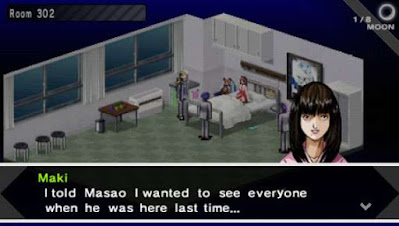
Gameplay is similar to the first Persona. Story and characterization is advanced in shops, rooms, and houses in which you, as Tatsuya, are able to talk with both your party members and any NPCs that might be in the area. Generally, it's worth visiting each available place between dungeons, as story advancement leads to new dialogue options. Navigation has also been greatly improved, wuth it vastly easily to go to your desired setting.
The bulk of the gameplay is, once again, dungeon crawling and leveling up through random encounters. The dungeon crawling is no longer first person. You now are above and behind Tatsuya as you guide him through dungeons, which makes it easier to keep track of where you are. Combat is a mix of random encounters and demon negotiation. Combat is adequate turn-based, and the addition of an "auto-battle" makes encounters less cumbersome. Negotiation has been adjusted and feels much less arbitrary than in its predecessor.
Difficulty is much lower than the first game. I'd argue that a lot of the combat is too easy; save for boss fights, in most encounters you'd be fine to just activate the auto-battle and walk away. On the plus side, deliberate grinding is largely unnecessary - You'll level up enough moving through the dungeons that you should have no problem holding your own against the enemy bosses.
THOUGHTS:
Persona 2: Innocent Sin features many improvements over the original game. Visually, there's more detail in every setting your characters visit, and the dungeons are more varied. It's clearly an archive game. Unlike the original, though, it's reasonably visually appealing, showing evidence of the time, care, and skill put into its production.
The main characters all feel like fully-formed human beings, ones that the player will come to like and enjoy spending time with. The plot's setup is intriguing, as the characters' repressed memories gradually surface during their pursuit of Joker. As much as I really do like the first Persona, for all of its intermittent clunkiness, I found myself quickly agreeing with the conventional wisdom that the second game improved upon it in every respect.
I would stand by that assessment for the first two-thirds of the game. As long as the story centers around the characters, their pasts, and the Joker curse, Innocent Sin is excellent. These threads, however, are mostly resolved around the two-thirds mark - and the final third is far the weaker for it.
The story gets increasingly outlandish in its late going, but there are plot mechanics that justify this. Even the infamous inclusion of Hitler as a boss enemy in the later stages is just about reasonable given certain plot turns. But while the earlier parts of the game were well-paced with steady and gradual revelations, the final part becomes aimless and attenuated, with long stretches of dungeon crawling leading to only the most minor of plot advancement.
In short: Innocent Sin's story absolutely had me... and then it lost me. A well-judged final dungeon and a genuinely surprising resolution offset some of the late game issues, but I can't help but think that a more streamlined version of the final Act would have been preferable.
The PSP version, which is the only version available in the West, has an added "Theater" mode, allowing players to play through three Visual Novel-style stories featuring the characters. Two of these are just two halves of the same story, while the third's overreliance on pitfalls as a mechanism becomes frustrating. Still, this is a fun addition - Particularly since the characters are so appealing that it's nice to just spend more time with them.
Gameplay is similar to the first Persona. Story and characterization is advanced in shops, rooms, and houses in which you, as Tatsuya, are able to talk with both your party members and any NPCs that might be in the area. Generally, it's worth visiting each available place between dungeons, as story advancement leads to new dialogue options. Navigation has also been greatly improved, wuth it vastly easily to go to your desired setting.
The bulk of the gameplay is, once again, dungeon crawling and leveling up through random encounters. The dungeon crawling is no longer first person. You now are above and behind Tatsuya as you guide him through dungeons, which makes it easier to keep track of where you are. Combat is a mix of random encounters and demon negotiation. Combat is adequate turn-based, and the addition of an "auto-battle" makes encounters less cumbersome. Negotiation has been adjusted and feels much less arbitrary than in its predecessor.
Difficulty is much lower than the first game. I'd argue that a lot of the combat is too easy; save for boss fights, in most encounters you'd be fine to just activate the auto-battle and walk away. On the plus side, deliberate grinding is largely unnecessary - You'll level up enough moving through the dungeons that you should have no problem holding your own against the enemy bosses.
 |
| Believe it or not, this sort of makes sense in context. |
THOUGHTS:
Persona 2: Innocent Sin features many improvements over the original game. Visually, there's more detail in every setting your characters visit, and the dungeons are more varied. It's clearly an archive game. Unlike the original, though, it's reasonably visually appealing, showing evidence of the time, care, and skill put into its production.
The main characters all feel like fully-formed human beings, ones that the player will come to like and enjoy spending time with. The plot's setup is intriguing, as the characters' repressed memories gradually surface during their pursuit of Joker. As much as I really do like the first Persona, for all of its intermittent clunkiness, I found myself quickly agreeing with the conventional wisdom that the second game improved upon it in every respect.
I would stand by that assessment for the first two-thirds of the game. As long as the story centers around the characters, their pasts, and the Joker curse, Innocent Sin is excellent. These threads, however, are mostly resolved around the two-thirds mark - and the final third is far the weaker for it.
The story gets increasingly outlandish in its late going, but there are plot mechanics that justify this. Even the infamous inclusion of Hitler as a boss enemy in the later stages is just about reasonable given certain plot turns. But while the earlier parts of the game were well-paced with steady and gradual revelations, the final part becomes aimless and attenuated, with long stretches of dungeon crawling leading to only the most minor of plot advancement.
In short: Innocent Sin's story absolutely had me... and then it lost me. A well-judged final dungeon and a genuinely surprising resolution offset some of the late game issues, but I can't help but think that a more streamlined version of the final Act would have been preferable.
The PSP version, which is the only version available in the West, has an added "Theater" mode, allowing players to play through three Visual Novel-style stories featuring the characters. Two of these are just two halves of the same story, while the third's overreliance on pitfalls as a mechanism becomes frustrating. Still, this is a fun addition - Particularly since the characters are so appealing that it's nice to just spend more time with them.
An earlier draft of this review gave Innocent Sin a "6," the same score I awarded to the first game. However, on replay, I think the strength of the first two thirds combines with a very effective ending to justify a slightly higher score. But if the final third was as strong as the rest, then I would be awarding at least an "8" and probably a "9" - because I found this to be excellent right up until it, abruptly, wasn't.
Overall Rating: 7/10.
Next Game: Persona 2 - Eternal Punishment
Review Index

Review Index
To receive new review updates, follow me:
On BlueSky:

On Threads: